Back to blogFrom Leus 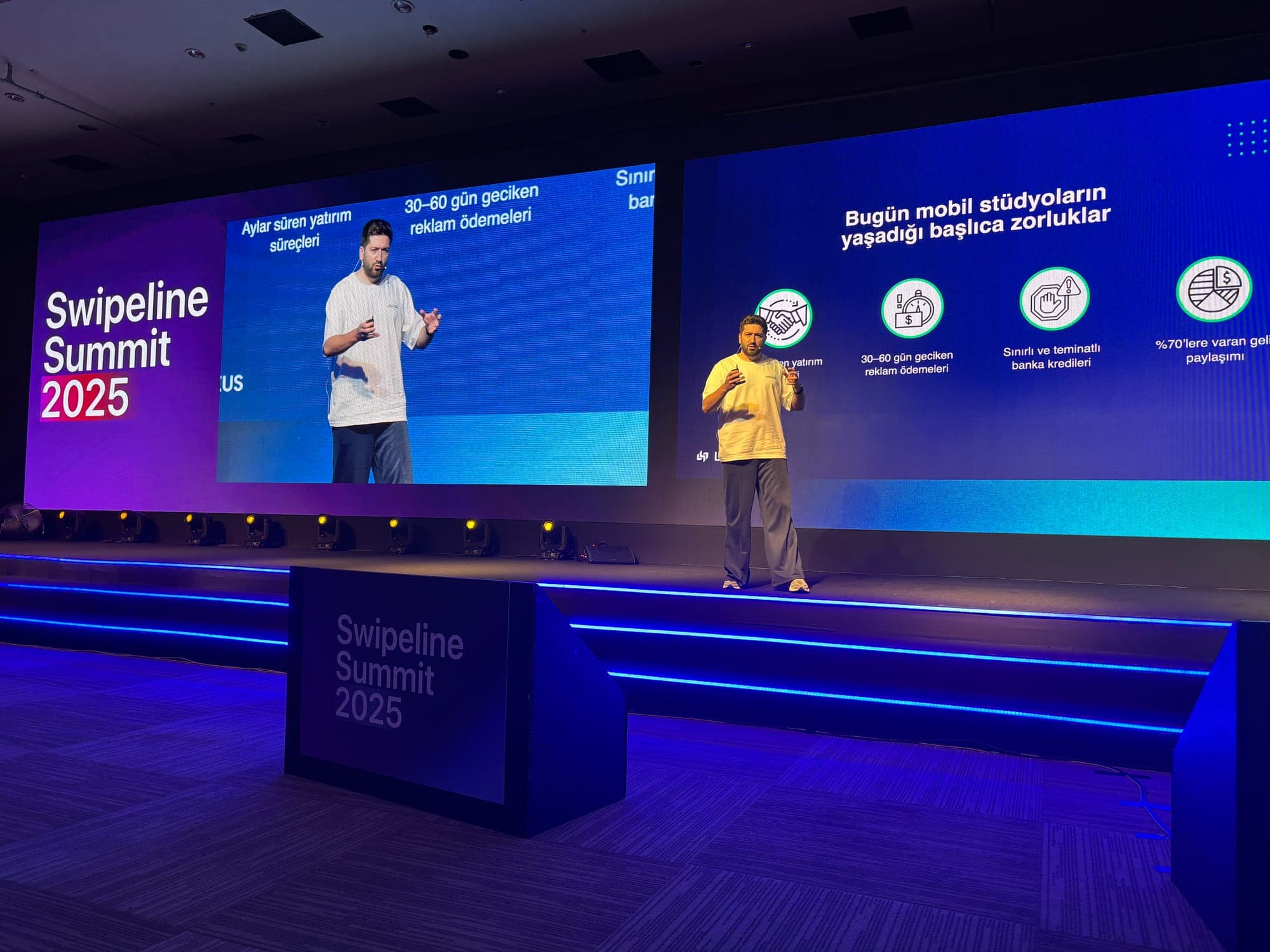
Swipeline Summit 2025: Stories from the Heart of Turkey’s Tech Scene
This year Swipeline Summit 2025 was held in Antalya between April 28–30, and became a vibrant meeting point where the pulse of the tech world was felt deeply. With the stories told on stage and the companies that presented, the event proved that this ecosystem is not just about lines of code and market share—it’s about culture, vision, and boldness. From AI to entrepreneurship, investor relations to the future of money, every insight shared was a testament to the future Turkey is building in tech.
This article brings together key highlights from pioneering companies that took the stage—striking data, inspiring visions, and, most importantly, strong messages about the new generation of entrepreneurship.
Akbank LAB: Beyond Banking—A True Innovation Hub
Opening the summit, Akbank LAB made a bold declaration: "We want to rewrite finance." This wasn’t just a tagline—it’s a strategy backed by real action:
- In the past 9 years, they’ve run 46 proof-of-concept (PoC) trials with startups; 22 of these have successfully moved into production.
- Currently, they’re collaborating with 7 startups—innovation is a constant process.
- Their internal innovation program, Akbank Plus, has already launched 4 ventures, investing $2 million in total—showing strong institutional support for in-house entrepreneurship.
- Perhaps most striking: they accept a 60% failure rate for pilots. This illustrates a conscious innovation strategy where failure isn’t feared—it’s part of growth.
With its bold and forward-thinking innovation mindset, we strongly believe Akbank LAB will play a leading role in shaping the future of the gaming and app ecosystem too.
Codeway: The Quiet Giant of Mobile
Codeway delivered a clear message about AI: “AI isn’t big words—it’s practical value for the user.” Their achievements with this pragmatic approach in just a short period of 5 years are impressiveTheir results speak for themselves:
- Developed over 60 mobile apps.
- Their AI-driven applications generate 5 times more revenue compared to others —clear evidence of AI’s commercial power.
- Their Retake app optimizes photos through user interaction, targeting leadership in a $2B market.
- Their culture is built on three principles: Curiosity as a compass, Trust as glue, and Passion as fuel.
A pivotal moment in Codeway’s trajectory was their 2022 decision to focus on AI. The impact of the strategic agility they demonstrated during this transformation is clearly evident. We believe that the freedom of movement afforded by the company never having previously taken on external investment also played a significant part in this strategic agility.
Rollic: Redefining the Rules of the Game
Rollic, one of the giants in the mobile gaming world, is undergoing a significant strategic transformation. Once heavily reliant on ad-based revenue through the hyper-casual model, the company is now shifting to a hybrid revenue model that combines ads with in-app purchases—a deliberate move aimed at increasing player engagement and diversifying income streams.
They illustrated this shift using their Color Block game as an example:
- 80% of their revenue now comes from in-app purchases, showing that players find real value in the game and are willing to pay for it.
- Player experience is no longer limited to a few minutes of play, but is designed to last for weeks with increasing depth.
- User psychology plays a central role in level design—they aim to keep players engaged and motivated without causing frustration or fatigue.
When it comes to AI, Rollic takes a grounded stance: they openly acknowledge that no AI is currently capable of true creative game design. Instead, they use AI as a powerful tool to accelerate creative production (such as ad visuals) and deepen data analysis.
The success of projects like Color Block Jam, along with the substantial increase in both revenue and expenses, also highlights an important insight: during periods of rapid growth, studios may face sudden financial needs—and quick access to funding can become absolutely critical.
Popcorn: Real Talk Between Founders and Investors
One of the most heartfelt and unfiltered sessions of the event was Popcorn AMA (Ask Me Anything), where investors and entrepreneurs came together for an open dialogue. The questions were direct, and the answers refreshingly honest. Here are some of the standout takeaways:
- “The founder is the biggest investor in their own startup.” This powerful statement highlighted the importance of passion and personal commitment.
- Finding funding isn’t about perfection—it’s about the right timing and story. Strategic alignment can be just as crucial as financial support.
- Not every VC is AI-obsessed; bold claims like “I only invest in AI” often reflect niche strategies rather than broader market realities.
- And perhaps the deepest insight: “It takes courage not only to start—but also to stop.” Accepting failure and knowing when to move on is also part of the entrepreneurial journey.
This session was a strong reminder that entrepreneurship is not just about bright ideas—it demands strategy, access to the right financial resources, and the courage to make difficult decisions.
LEUS: No More Waiting. Growth Accelerates.
Just as the conversation turned to funding and growth, our founder Halil İbrahim Özdemir took the stage to spotlight one of the mobile ecosystem’s biggest challenge: "Fast and Flexible access to capital". App and game developers often face delayed revenues and rigid financing models—barriers that limit their ability to scale.At Swipeline Summit 2025, LEUS introduced a bold solution in a talk titled “The End of Waiting for Cash Flow: A New Dawn for App and Gaming Financing.” LEUS delivers a powerful set of value propositions:
- Performance-based, non-dilutive, fast capital – enabling founders to scale without giving up equity or control.
- Access to platform and ad revenues in as little as 2–3 days, accelerating cash flow and boosting marketing and operational capacity.
- Fully digital, collateral-free, founder-friendly processes – offering a transparent and efficient financing model.
- AI-powered ROAS and LTV predictions, plus industry benchmarks – empowering founders to make data-driven decisions.
At LEUS, we emphasized that in a fast-growing, mobile-first market like Turkey, app and game studios don’t need to wait—they need to move faster.With our newly developed ROAS-based financing model, we believe we can truly empower teams by providing the speed and flexibility they need to scale effectively.
Our closing message was clear:
With LEUS, waiting is over. Revenue, speed, and strategy are now in your hands.
Figopara: AI Is a Tool, Not Magic
Koray Gültekin Bahar, founder of Figopara, shared a refreshingly honest take on artificial intelligence. While he acknowledged its potential, he didn’t shy away from pointing out its flaws: “AI acts like it knows everything—but sometimes it just makes things up.” Anyone who's worked with AI has probably laughed (or cried) at just how confidently it can be completely wrong.
To make AI genuinely useful, Gültekin emphasized two key principles:
- Verification is essential: AI outputs must always be cross-checked using other models or methods. Blind trust in a single model is a risky game.
- Data = Meaning (But Be Careful): While the mantra “no data, no meaning” holds true, poor-quality or irrelevant data is just noise. Data must be clean and interpreted wisely for AI to add real value.
Figopara takes these principles seriously—and turns them into action:
- Practical Implementation: Feeding their systems with 4.5 TB of data, Figopara generates insights that help predict payment risk, assess sales rep performance, and match customers with the right financial products.
Koray Gültekin Bahar also shared a bold prediction about the future of AI: “Zero UI”—a world where we interact with systems not through screens, but by simply talking to them. It’s not science fiction anymore; it’s a revolution waiting just around the corner.
Clave: Redefining Money in the Age of the Internet
Our relationship with money is undergoing a fundamental transformation—and Clave aims to be at the forefront of that shift. On stage, their message was clear:“The era of internet-native money has begun.”
So what does the future of money—digital and borderless—look like according to Clave’s vision?
- Full user control: With a decentralized structure, users should have complete ownership over their finances.
- Borderless speed: Money should move anywhere in seconds, effortlessly.
- Minimal cost: Transaction fees should be near zero, making financial access truly inclusive.
Clave offers a solution that delivers on these promises: blockchain-based, biometric-secured smart accounts. With just a username, users can send and receive money instantly, and spend it anywhere using the Clave card. The goal? To make everyday financial transactions radically simpler, faster, and more accessible to everyone.
MCP: A Universal Socket for AI Is on the Way
One of the most technically exciting presentations at the event came from Bertuğ Oymak, founder of AgentiPy, who introduced the Model Context Protocol (MCP). Oymak highlighted a major bottleneck in today’s AI applications: Connecting an AI model to different services—like a calendar app or an e-commerce platform—requires custom, complex integrations due to each service’s unique architecture. This complexity slows down AI deployment and limits its usability across platforms.
MCP is designed to solve exactly that—a standardized protocol to eliminate integration chaos.So what does MCP promise?
- Single Integration, Multiple Capabilities: Through a single MCP-based integration, an AI agent could understand and execute over 200 different actions—like booking appointments, searching for products, and more.
- Easy Automation: Thanks to visual interfaces like Zap to Zap, businesses can build their own AI automations without writing code.
- Universal Connectivity (Think USB-C for AI): Just as USB-C enables different devices to connect through one universal port, MCP aims to be a standardized data socket for AI—allowing seamless communication across platforms. This could be a game-changer for the AI ecosystem.
At LEUS, we’ve also experienced the challenges of fragmented AI integrations in our own automation processes. That’s why AgentiPy’s vision of standardization through MCP deeply resonated with us—and reflects a need we see growing across the ecosystem.
Leadership in the Age of AI: Balancing Experience, Intuition, and Technology
One of the most thought-provoking moments of the summit was the candid and insightful conversation between Tuğrul Ağırbaş, founder of Genwise and Levent Kömür, CEO of Uludağ İçecek. Their discussion offered a glimpse into how senior leaders are beginning to position AI not just as a tool—but as a thinking partner.
Key insights from their dialogue included:
- AI is not a rival—it’s a thought partner: The true value of AI lies not in accelerating what we already know, but in prompting us to think beyond the obvious. In this sense, AI was framed as a catalyst for strategic thinking.
- Thinking with data: Thanks to AI’s vast memory and ability to uncover patterns, leaders are now able to transcend the natural limits of the human mind and approach decisions from broader and deeper perspectives.
- Tools may evolve, but the essence of leadership remains: While digital transformation changes the way we operate, core leadership principles—creating meaning, setting vision, and guiding people—remain as vital as ever.
- Leadership is defined by impact, not titles: True leadership is not about hierarchy or status, but about the influence one creates. In this new era, authenticity and human-centered approaches continue to matter.
This conversation revealed a powerful shift in mindset: today’s leaders are embracing AI not only for operational efficiency but also as a lever in deeper, strategic thought processes—seeking to harmonize technological advancement with human-centric leadership.
Final Thoughts: Courage, Technology, and the New Rule-Makers
Swipeline Summit 2025 made one thing clear: Turkey’s entrepreneurial ecosystem has moved beyond the stage of bright ideas. It has reached a point where scalable products, capable teams, sound strategies, and intentional company cultures are being built. What we saw on stage wasn’t just talk of growth—but of how to grow, with whom, and what kind of value to create along the way. This was a strong sign of a maturing ecosystem that believes in itself more than ever.
And at the core of all these visions, strategies, successes—and even failures—was a simple yet powerful loop that captured the spirit of the summit:
“Imagine. Test. Validate. Scale. Start again.”
Yes, the bold new stories being written on Turkey’s tech stage are fueled by courage, persistence, and a relentless cycle of experimentation.
01You already made it
See what your cohorts are worth.
Connect your MMP and get a studio report in a few hours. No pitch deck, no equity.