
Notes From Mobile Week Istanbul: 7 Key Signals Shaping the Global Mobile Ecosystem
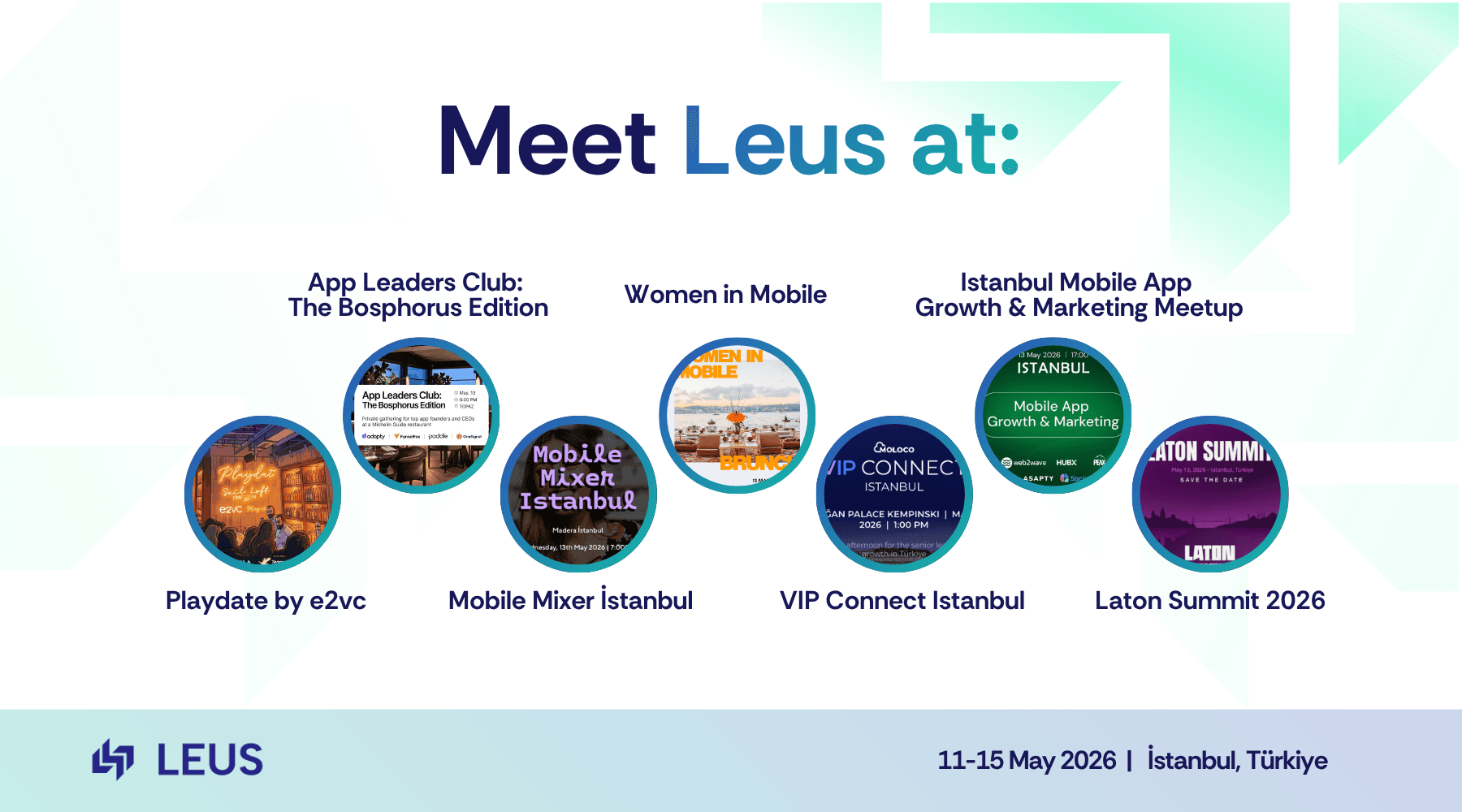
Seven events in five days. Founders, operators, ad-tech leads, and global investors from top-tier gaming and mobile app studios, leading ad-tech networks, innovative platform providers, and institutional financiers all in the same city, in the same week.
There was no formal headline. The signal was the calendar itself. Between May 11 and 15, the center of gravity of the global mobile ecosystem officially moved to Istanbul. The Leus team was on the ground across the city's most exclusive gatherings, collecting raw insights directly from the rooms where the future of mobile growth and user acquisition is being written.
Here is the complete 7-event lineup that shaped our week and our notes:
- Women in Mobile Brunch by the Bosphorus (Hosted by Leus)
- Laton Summit 2026 (Hosted by Laton Ventures)
- App Leaders Club: The Bosphorus Edition (Hosted by Adapty.io, FunnelFox, Paddle, OneSignal)
- Istanbul Mobile App Growth & Marketing Meetup (Hosted by HubX, web2wave, Asapty, SocialPeta)
- VIP Connect Istanbul (Hosted by Moloco)
- Mobile Mixer Istanbul (Hosted by Adjust)
- Playdate (Hosted by e2vc, Xsolla, Tencent Games)
Here are the seven major signals from Mobile Week Istanbul that every founder and operator needs to track.
1. Türkiye is No Longer "The Rising Market." It Is the Global Mobile Gaming Capital.
For years, Türkiye was discussed as a talent pool with cheap user acquisition (UA) and a few breakout studios. That framing is officially outdated. Driven by a decade of relentless execution, Istanbul is now openly recognized as the global capital of mobile gaming.
The structural weight of this market was the core theme at Laton Summit, which gathered 300 exclusive attendees from 150 companies across 20 countries. The most staggering data point defining this shift lies in the global capital allocation: during the past year, a massive 75% of all global mobile gaming investments were made in Türkiye, fueling an ecosystem that now boasts 733 active studios.
This hyper-growth is a historic example of building an industry from scratch through a compounding cycle of successful founders mentoring the next generation. This momentum is further accelerated by a robust, multi-stakeholder ecosystem that bridges high-calibre talent with powerful institutional support, ranging from global partners like Google, Appcharge, and Aream & Co. to sovereign backing from the Investment Office of the Presidency of the Republic of Türkiye.
This strong governmental and institutional backing highlights a critical competitive advantage for local teams. At Leus, we mirror this macro support on an operational level by providing dedicated partnerships for government incentives advisory alongside our structured growth financing options, ensuring studios can seamlessly unlock state subsidies while maintaining absolute capital efficiency.
Grand Games’ fireside chat served as the ultimate proof of this compounding speed, highlighting their massive jump to a $70M Series B and recently securing the #1 and #2 slots for most downloaded games on the US iOS App Store.
The investor panel made the global consensus sharper. Scopely's Rob Ricca called Türkiye an "outlier market" where investment appetite stays incredibly strong even as global PC and console funding slows down. Supercell's Janne Snellman delivered a major strategic signal, stating that while they heavily prioritize founder trust and minority investments, Supercell is now much more open for acquisitions. Tencent's Nachuan Li flagged ongoing conviction in casual puzzle, next-gen match-3, and hybrid-casual contenders looking for the next breakout opportunity.
When strategic investors of that calibre publicly position a single city as a priority market, that is not interest. That is consensus.
2. Retention & Revenue Architecture: The Focus Shifted to Post-Activation
At the exclusive, off-the-record App Leaders Club: The Bosphorus Edition at Topaz Istanbul, the conversation among senior leaders shifted away from raw acquisition toward the mechanics of compounding revenue.
With acquisition channels becoming fiercely expensive, the industry's brightest minds spent hours discussing paywall optimization, advanced onboarding flows, and building subscription infrastructures that mitigate churn before it happens. The key takeaway? Driving a download is only 10% of the battle; the real margin is won or lost in how seamlessly an app activates a user and structures its remote-config paywalls in the first days of user onboarding.
3. The Power of Community: Women in Mobile Take the Lead
One of the most remarkable highlights of the entire week was our very own Women in Mobile Brunch by the Bosphorus. Without a doubt, this was one of the week's most inspiring gatherings.
Beyond the standard industry networking, it was a space where the most influential women leaders in the mobile ecosystem came together for candid, profound conversations. From diving deep into daily operational building to mapping out new, high-impact cross-border collaborations, the energy in the room transcended traditional business meetings. It truly felt like the foundational spark of a massive, long-term community. At Leus, we are incredibly proud to have initiated, hosted, and led this movement. True growth happens when operators support operators, and empowering this community is a core part of that mission.
4. UA Economics Tightened: Capital Discipline and Creative Financing Portfolio
Across almost every single gathering last week, our conversations with countless mobile app and gaming studios kept returning to the exact same structural reality: Cost Per Install (CPI) metrics are climbing, attribution tool costs are rising, and growth budgets require tighter operational planning than they did 12 months ago.
This unrelenting financial pressure has completely rewritten how modern mobile operators view liquidity. Capital is no longer a binary fundraising decision; it is a portfolio optimization decision. Studios with strong product-market fit are asking a much more tactical question: not "where do I raise capital from," but "which financing structure fits this specific 30-to-90 day scaling window."
This shift has put UA Financing at the very center of the growth conversation. Relying solely on dilutive venture capital equity to fund ongoing marketing spend is becoming an outdated playbook. Instead, smart studios are turning to creative, non-dilutive growth capital and alternative financing structures specifically designed to scale user acquisition. By leveraging UA financing, teams can aggressively scale their campaigns during critical high-ROI windows without sacrificing equity, giving them the flexibility to fund growth directly through future receivables and predictable cohort performance.
5. Creative Production and Algorithmic Targeting Refined by AI
Narrow targeting is dead. The absolute proof of this structural shift came during the Istanbul Mobile App Growth & Marketing Meetup, where an industry-leading panel comprising experts from Meta, SocialPeta, and HubX dissected the ad creative landscapes that work in 2026.
The industry consensus is clear: user acquisition has moved fully to algorithmic learning. Mobile ad networks find the right user automatically, but only if the creative production volume is high enough to feed the algorithm's testing appetite.
The operational implication landed hard: running one creative per campaign no longer works. Multiple high-quality creatives per campaign is now the baseline floor, not the ceiling. This is where Meta’s updated Advantage+ Creative (GenAI) suite comes into play. As the panel highlighted, UA teams are now leveraging Meta’s native AI tools to automatically generate close visual and textual variants of their best-performing ads, adapt static assets into automated video variations, and utilize generative image expansion.
As SocialPeta's data trends show, this automation cuts creative production bottlenecks significantly. However, sheer volume alone does not solve the harder problem: which creative concepts are actually worth producing in the first place? That exact gap, which lies between using AI to produce more variants and knowing the right thematic angles to test, is where competitive creative intelligence separates winning studios from the rest.
This is exactly why we built Visua. Instead of briefing creative teams based on gut feel or expensive guesswork, Visua provides data-driven, competitive creative insights to ensure every concept is backed by performance metrics before production even begins.
This convergence of volume and intelligence is driving the evolution of the modern growth stack. At Leus, we are channeling this evolution into the agentic growth platform we are currently developing; a next-generation infrastructure where intelligent AI agents seamlessly unify creative insights, predictive analytics, and automated financing execution into a single, autonomous engine for mobile operators.
6. Deep-Tech and AI-Driven Architecture: Scaling Beyond Pure Capital
At VIP Connect Istanbul, the Moloco team brought together 40 exclusive gaming founders, executives, growth leads, and investors for a deeply strategic afternoon. The experience mirrored the evolution of UA itself: starting with high-level alignment during a lunchtime cruise on the Bosphorus via the Çırağan Mega Yacht from Galataport, followed by four clinical, data-driven deep dives at the Çırağan Palace Kempinski.
The sessions, opened by Senior Director of Growth Alex Pittaway, provided an unapologetic framework for the AI era. Michail Katkoff, founder of Deconstructor of Fun, laid down the operational law of the week: the studios compounding growth in 2026 are those linking acquisition, monetisation, and retention into a single surface, rather than treating them as separate silos.
The panels further mapped how player discovery and platform algorithms are rewriting the playbook. Viccy Winter analyzed practical AI-powered UA execution, showing how to effectively transition teams into letting models run multi-creative simulations. This technical shift intersected perfectly with a fiery debate on costs and channels led by Eric Kress and Kirti Patidar, who mapped how shifting platform economics are tightening UA margins in real time.
Concluded by Geoff Reinhardt's insights on how shifting global ad spend shapes immediate studio roadmaps, the overarching signal was clear: modern UA is no longer about human campaign optimization, it is about data pipelines. For studios, establishing predictive feedback loops is the only way to guide autonomous ad networks and survive the macro shift in digital advertising.
7. The Operational Tension: Self-Publishing vs. Publisher Partnerships
The industry conversations at Playdate and the HubX panels, specifically led by key operators from Peax, Goddess, and HappyDigital, kept returning to an unresolved operational tension regarding subscriptions, web funnels, and the ideal monetization mix. Traditional publisher partnerships offer rapid scale and distribution, but the economic returns inevitably saturate after a certain growth phase.
On the flip side, self-publishing and leveraging custom web funnels offer absolute operational control and higher profit margins, but the infrastructure load is intense. Operators and founders agreed that most indie teams heavily underestimate the specialized talent, engineering, and capital needed to run automated UA, data science, predictive finance, and rapid creative testing entirely in-house. The core question is no longer whether to self-publish, but exactly at what point on the studio's growth curve does the math flip. This decision is increasingly tied to a studio's access to predictive data analytics and capital independence.
What the Week Added Up To
Seven events, seven themes, one underlying signal. The mobile growth stack is no longer modular. Capital, data intelligence, and creative strategy are converging into a single decision surface. The studios pulling ahead are the ones treating them as one integrated growth engine instead of three separate departments.
This exact paradigm shift is what Leus was built to solve:
- Lumina: Turning predictive analytics and data science into clear scaling roadmaps.
- Visua: Providing advanced competitive creative intelligence to bridge the gap between creative volume and performance.
- Capital: Deploying flexible, non-dilutive growth capital tailored for exact user acquisition scaling windows alongside comprehensive government incentives advisory.
Built by mobile operators, for mobile operators.
If Mobile Week Istanbul reframed how you are thinking about your next scaling window, let's connect. The conversations from last week were the most valuable we have had all year, and they are far from finished.
[Learn more about how Leus empowers mobile growth. Let's build together.]